Product Description
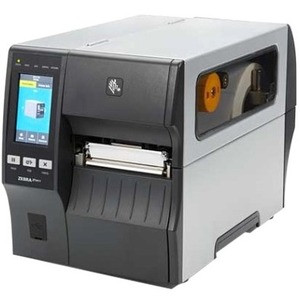
Zebra ZT411 Direct Thermal/Thermal Transfer Printer - Desktop - Label Print - Peel with Full Rewind The ZT411 has a 4.3-inch full-color touch display to see status at a glance, print width of 4 inches and print speeds of up to 14 inches per second. It offers high-resolution (600 dpi) printing. Add RFID capabilities to print and encode general UHF RFID tags or thicker on-metal tags.- Direct Thermal/Thermal Transfer Printer offers reliable performance with outstanding printing quality
- 203 maximum print resolution (dpi) for better reliance and added usability
- Delivers high-speed, hassle-free labeling solution for your business needs
- Share the printer easily and efficiently with various other systems with the help of built-in Ethernet port
- 39" maximum label length to easily accommodate your needs with added productivity
- Supports continuous paper media type for maximum feasibility and better accommodation of your requirements
- Direct Thermal/Thermal Transfer Printer with industrial application/usage provides dependable printing solution with added productivity
- Comes with 256 MB standard memory for timely printing with added reliability
Warranty Information
https://www.lpautomation.com/hubfs/ZT400%20Spec%20Sheet.pdf- Thermal transfer and direct thermal printing
- Thin film printhead with E³ Element Energy™ Equalizer for superior print quality
- 203 dpi print resolution (8 dots/mm)
- Print speed per second up to 14 in. (356 mm/second)
- USB 2.0, high speed
- RS-232 Serial (RS-232C with DB9F connector; configurable baud rate 2400–115,200kB, parity, and data bits; stop bits at 1 or 2; software (XON/XOFF) and hardware (DTR/DSR or RTS/CTS) handshake protocols)
- 10/100 Ethernet: supports an internally integrated option enabling Webview and Alert features
- Bluetooth® 4.1
- Dual USB Host
- 4.3 in. color touch display with intuitive menu for quick operation and settings management
- Bi-colored status LEDs for quick printer status
- ARM Cortex A7 processor
- 256 MB RAM memory (8 MB User Available)
- 512 MB Flash memory (64 MB User Available)
- Print Touch application
- Link-OS™-enabled
- Auto-switching 100–240V power supply
- ENERGY STAR® qualified
- Printhead element out detection
- Dual media sensors — transmissive and reflective
- 3 in. media supply hanger
- Auto calibration when printer is turned on or when printhead is closed
- Easy, side-loading metal print mechanism
- Tool-less printhead and platen replacement
- Metal media cover with enlarged clear viewing window
- Robust-gold user touch points indicating key adjustments
- Bi-fold media door decreasing overall operating space by 35%
- Resident ZPL™, ZPL II™ and EPL™ programming languages, selectable through software or front panel
- XML-Enabled Printing — allows XML communications for barcode label printing, eliminating license fees and printer server hardware while lowering customization and programming costs
- Printhead 203 dpi (8 dots/mm)
- Printhead 300 dpi (12 dots/mm)
- Printhead 600 dpi (24 dots/mm)
- Parallel (bi-directional interface)
- Wireless dual radio with 802.11ax Wi-Fi™ and Bluetooth 5.3
- Wireless dual radio with 802.11ac Wi-Fi™ and Bluetooth 4.2
- 10/100 Ethernet
- Applicator interface
- Rewind: Internally rewinds a full roll of printed labels on a 3 in. core, or peels and rewinds liner (factory installed only)
- Peel: Front-mount, passive peel option; or liner take-up — an additional full-roll liner take-up spindle accommodating the standard printer base
- Cutter: Front-mount guillotine cutter and catch tray, operating under software control to cut labels individually or in strips (not compatible with rewind and peel options)
- 1 in. I.D. core media supply hanger
- Ink-side-in ribbon supply spindle
- Fonts: Asian and other international scalable and smooth bitmapped fonts
- Power Cords: US, Europe/UK, Israel, China, Japan, Australia, Argentina, Brazil and Taiwan
- Linerless: Factory-installed linerless with direct thermal only; field-installable linerless upgrade kit
- RFID: Fully integrated UHF EPC Gen 2 V2.1/ISO 18000-63 RFID Reader/Encoder; prints and encodes tags with a minimum pitch of 0.6 in./16 mm; Adaptive Encoding Technology simplifies RFID setup and eliminates complex placement guidelines; field-installable on-metal RFID kit available for 203 and 300 dpi
- ZKDU Keyboard Display Unit: Enter variable data and retrieve stored forms for standalone applications (requires null modem adapter with DB9 serial cable)
- ZBI 2.0™: Field installed via activation file
- Vertical: less than ±0.039 in. (±1.0 mm) on non-continuous media
- Horizontal: less than ±0.039 in. (±1.0 mm) within a roll of media
- Media Types: Continuous, die-cut, notch, black-mark, linerless (optional)
- Maximum Label and Liner Length: 39 in. (991 mm) non-continuous at 203/300 dpi; 20 in. (508 mm) non-continuous at 600 dpi
- Media Web Width (Label and Liner): 1.00–4.50 in. (25.4–114 mm) tear/cutter; 1.00–4.25 in. (25.4–108 mm) peel/rewind
- Minimum Label Length: Tear-off, peel, and rewind modes: 0.5 in. (12.7 mm); Cutter: 1.00 in. (25.4 mm)
- Media Thickness (Label and Liner): 0.0023–0.010 in. (0.058–0.25 mm)
- Maximum Media Roll Dimensions: 8.0 in. (203 mm) O.D. on a 3 in. (76 mm) I.D. core
- Inter-label Gap: 0.079–0.157 in. (preferably 0.118 in.) / 2–4 mm (preferably 3 mm)
- Sensing Notch (W x L): 0.25 in. x 0.12 in. / 6 mm x 3 mm
- Sensing Hole: 0.125 in. diameter / 3 mm diameter
- Black Mark Length: 0.098–0.453 in. (2.5–11.5 mm)
- Black Mark Width: 0.37 in. (9.5 mm) or greater
- Black Mark Density: Greater than 1.0 Optical Density Units (ODU)
- Maximum Media Density: 0.5 ODU
- Ribbon Width: 2.00–4.33 in. (51–110 mm)
- Maximum Ribbon Length: 1,476 ft. (450 m)
- Maximum Ribbon Roll Size: 450 m: 3.2 in. (81.3 mm) O.D. on a 1.0 in. (25.4 mm) I.D. core
- Ribbon wound ink-side in can be used with the optional ribbon spindle
- 16 resident expandable ZPL II bitmap fonts and two resident scalable ZPL fonts
- Unicode™ for multi-language printing
- Web View — connect and control the printer via its web interface using a common browser
- Alert — network-connected printers provide alerts via email, wired, or wireless devices to minimize downtime
- Compatible with mainframe, mini, and PC hosts
- Four-position field rotation (0°, 90°, 180°, 270°)
- Variable field support (00 to 99); counter support (up to 10); variable field addition and subtraction
- Status reporting, form storage, and metered print odometer
- Linear Barcodes: Code 11, Code 39, Code 93, Code 128 with subsets A/B/C and UCC Case Codes, ISBT-128, UPC-A, UPC-E, EAN-8, EAN-13, UPC and EAN 2- or 5-digit extensions, Plessey, Postnet, Standard 2-of-5, Industrial 2-of-5, Interleaved 2-of-5, Logmars, MSI, Codabar, Planet Code
- 2D Barcodes: Codablock, PDF417, Code 49, Data Matrix, MaxiCode, QR Code, TLC 39, MicroPDF, RSS-14 (and composite), Aztec
- Barcode Ratios: 2:1, 7:3, 5:2, 3:1
Standard Features — Printing
| Parameter | 203 dpi (8 dots/mm) | 300 dpi (12 dots/mm) | 600 dpi (24 dots/mm) |
|---|---|---|---|
| Dot Size (W x L) | 0.0049 in. x 0.0049 in. (0.125 x 0.125 mm) | 0.0033 in. x 0.0039 in. (0.084 x 0.099 mm) | 0.0016 in. x 0.0016 in. (0.042 x 0.042 mm) |
| Maximum Continuous Media Print Length | 157 in. (3988 mm) | 73 in. (1857 mm) | 39 in. (991 mm) |
| Maximum Print Width | 4.09 in. (104 mm) | 4.09 in. (104 mm) | 4.09 in. (104 mm) |
| Programmable Print Speeds (per second) | 2.4–14 in. (61–356 mm), 1 in. increments | 2.4–10 in. (61–254 mm), 1 in. increments | 1.5–4 in. (38–102 mm), 1 in. increments |
First Dot Location: Measured from inside media backing edge: 0.10 in. ±.04 in. (2.5 mm, not to exceed -.5 mm +1.0 mm)
Media Registration Tolerance:
Sensor adjustment range: 0.06–2.81 in. from media inner edge
Sensor adjustment range: 0.06–2.81 in. from media inner edge
ZPL II® — Universal language for Zebra printers, simplifying label formatting and enabling format compatibility with existing systems that run Zebra printers.
The ZT411 is powered by Link-OS, Zebra's robust printer operating system, and Zebra DNA for Printers — a set of tools and applications designed to optimize printer performance over its entire lifecycle, for better performance, simplified remote manageability, and easier integration.
Product Videos
Custom Field
Manufacturer Zebra
Model ZT411
Product Type Label Printer
Print Resolution 203 DPI
Max Print Width 4 in.
Printing Technology Thermal Transfer / Direct Thermal
Interface USB 2.0, RS-232 Serial, 10/100 Ethernet, Bluetooth 4.1, Dual USB Host
Display Type Color Touch
Printer Options Peeler With Full Rewind