
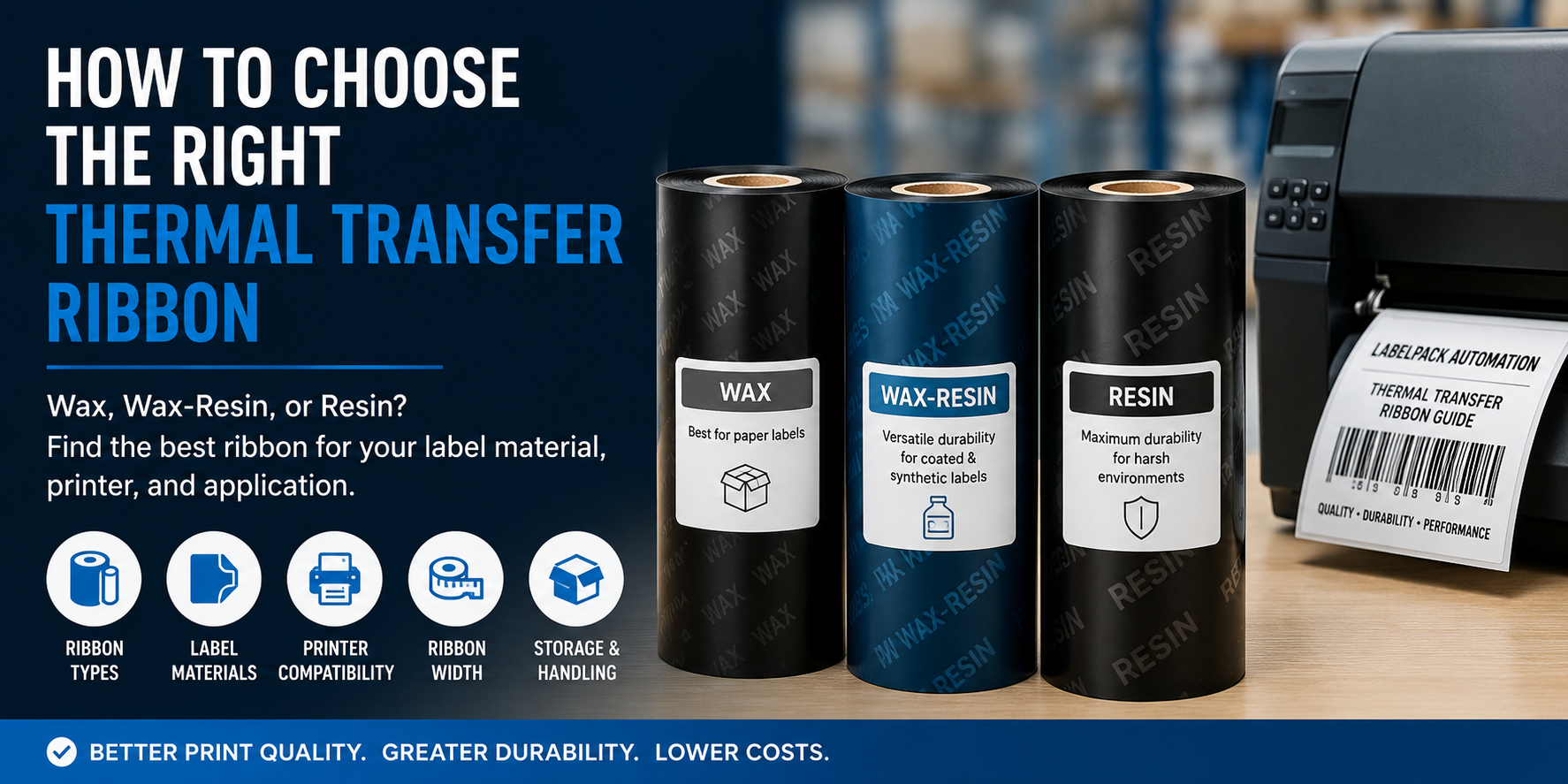
How to Choose the Right Thermal Transfer Ribbon
Jun 24th 2026
Selecting the right thermal transfer ribbon doesn’t have to be complicated. Most applications can be covered by one of three ribbon types: Wax, Wax-Resin, or Resin. Understanding the differences can help improve print quality, increase label durability, and reduce unnecessary costs.
Step 1: Start with Your Label Material
The first factor to consider is what you are printing on.
- Paper labels typically work well with wax ribbons.
- Coated paper, some synthetic labels and paper labels where you need a little more durability often benefit from wax-resin ribbons.
- Film labels such as polyester, polyimides, and some polypropylenes generally require resin ribbons for proper durability and adhesion.
If you are unsure, please don’t hesitate to reach out to us. We have decades of experience and can help guide you in your decision.
Step 2: Should Your Ribbon be Coated Side (CSI) or Coated Side Out (CSO)
These classifications refer to whether the ink is facing the inside or the outside of the ribbon roll. This is printer dependent and determines how the ribbon is wound and fed through the printer. If you are currently using a ribbon, and you are not sure which it is, you can take the adhesive side of a label or a piece of scotch tape and stick it to the outside of the ribbon roll. If ink sticks to the adhesive, it is CSO. If not, it is CSI.
Printers compatible with CSI ribbons are Sato and Datamax. Printers compatible with CSO are Zebra and Intermec.
Step 3: Choose your ribbon type.
Wax Ribbons: The Most Economical Choice
Wax ribbons are most used in short term labeling situations and are ideal for
- Shipping labels
- Warehouse labels
- Inventory tracking
- Product identification with limited handling.
Advantages:
- Lowest cost option
- Excellent print quality on paper labels
- Prints at a lower heat setting, extending printhead life.
- Good performance for standard indoor applications.
Limitations:
- Less resistant to abrasion, chemicals, and heat (the image will smear)
- Not recommended for harsh environments
Note the ribbon carrier will melt or distort if you attempt to use high heat settings in poorly matched media applications.
Resin Enhanced Wax (sometimes referred to as Premium Wax)
Some ribbon manufacturers offer resin-enhanced wax ribbons, sometimes referred to as premium wax ribbons. These products contain a small amount of resin blended into the wax formulation, providing improved durability without the cost of a full wax-resin ribbon.
Benefits:
- Better scratch and smudge resistance than standard wax
- Improved performance on coated paper labels
- Cost effective upgrade from standard wax
Typical Applications:
- Retail labels
- Product labels
- Distribution Centers
- Applications requiring slightly greater durability
Wax-Resin Ribbon: The Middle Ground
Wax-resin ribbons combine the affordability of wax with the durability of resin.
Best for:
- Gloss paper labels
- Polypropylene labels
- Some polyester
- Labels exposed to moderate handling or environmental conditions (testing is always recommended)
Advantages:
- Improved abrasion resistance
- Better chemical resistance
- Sharper image quality on synthetic materials
- Longer lasting print compared to wax ribbons
Commons Applications:
- Shelf labels
- Compliance labels
- Asset tracking
- Healthcare labeling
- Manufacturing environments
When a standard wax ribbon isn’t durable enough, but a full resin seems excessive, wax-resin can be an ideal solution.
Resin Ribbon: Maximum Durability
Resin ribbons are designed for the most demanding labeling environments.
Best for:
- Polyester labels
- Polyimide labels
- Outdoor applications
- High temperature environments
- Chemical Exposure
Advantages:
- Excellent scratch resistance
- Superior solvent and chemical resistance
- Outstanding durability
- High heat resistance
- Long-term readability
Common Applications:
- Automotive manufacturing
- Electronics labeling
- Chemical containers
- Laboratory labels
- Rating plates
- Outdoor equipment labels
While resin ribbons cost more, they provide the highest level of print permanence when label failure is not an option. Resin ribbons will typically require higher heat/darkness settings on your printer.
Step 4: Choose the Correct Ribbon Width
Ribbon width is just as important as ribbon formulation. A common mistake is selecting a ribbon that only covers the printed image area. The ribbon needs to cover the entire width of the label and backing material.
Using a ribbon slightly wider than the labelstock helps:
- Protect the printhead from premature wear
- Ensure complete image coverage
- Compensate for minor alignment variations
Step 5: Storage and Handling Considerations
Thermal Transfer Ribbon Storage Guidelines
Thermal transfer ribbons contain coatings that can be affected by temperature, humidity, and handling. Proper storage helps maintain print quality, ribbon performance, and shelf life.
Recommended Storage Conditions
Temperature: Store in a cool, dry environment. This can vary by ink type and supplier, but typical recommendation is 41°F to 75°F with 72°F and 50% RH being optimal.
Humidity: Avoid excessive humidity. Typical recommendations (again, this can vary by supplier) are 20% to 80% RH, non-condensing. Optimal is 50% RH.
Sunlight: Keep ribbons away from direct sunlight and UV exposure.
Packaging: Keep ribbons in their original packaging until use whenever possible.
Shelf Life: Recommended usage is within 1 year
You want to make sure not to store ribbons near heaters, in hot warehouses, or inside vehicles as it can soften the ribbon coating and lead to smudging, sticking, or poor print quality. Store ribbons in a clean and dust free environment. Dust or debris on the ribbon surface can transfer on to the printhead and affect print quality.
Handling Best Practices
- Allow Temperature Acclimation. If ribbons were stored in a cold warehouse and are brought into a warmer print room, allow them to acclimate before use to prevent condensation.
- Use FIFO Inventory. First-In, First-Out inventory rotation helps ensure older ribbons are used before newer stock.
- Protect Open Rolls. Partially used ribbons should be stored in a clean bag or container to reduce dust and contamination.
Still unsure? You can always send us your label material and application details. We will have the technical experts at LabelPack Automation help you select the right ribbon and print settings for your printer and provide test samples.